

NCERT Solutions for Chapter: Dual Nature of Radiation and Matter, Exercise 1: MCQ
NCERT Physics Solutions for Exercise - NCERT Solutions for Chapter: Dual Nature of Radiation and Matter, Exercise 1: MCQ
Attempt the practice questions on Chapter 11: Dual Nature of Radiation and Matter, Exercise 1: MCQ with hints and solutions to strengthen your understanding. NCERT Exemplar Physics - Class 12 solutions are prepared by Experienced Embibe Experts.
Questions from NCERT Solutions for Chapter: Dual Nature of Radiation and Matter, Exercise 1: MCQ with Hints & Solutions
A particle is dropped from a height . The de Broglie wavelength of the particle as a function of height is proportional to

The wavelength of a photon needed to remove a proton from a nucleus which is bound to the nucleus with energy is nearly
Consider a beam of electrons (each electron with energy ) incident on a metal surface kept on an evacuated chamber. Then
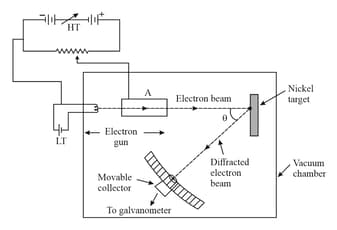
Suppose the voltage applied to A is increased. The diffracted beam will have the maximum at a value of that
A proton, a neutron, an electron and an -particle have same energy. Then their de Broglie wavelengths compare as
An electron is moving with an initial velocity and is in a magnetic field . Then it's de Broglie wavelength
An electron (mass m) with an initial velocity , is in an electric field (constant ).It's de Broglie wavelength at time is given by
An electron (mass m) with an initial velocity is in an electric field . If, , it's de-Borglie wavelength at time is given by


