

EASY
Earn 100

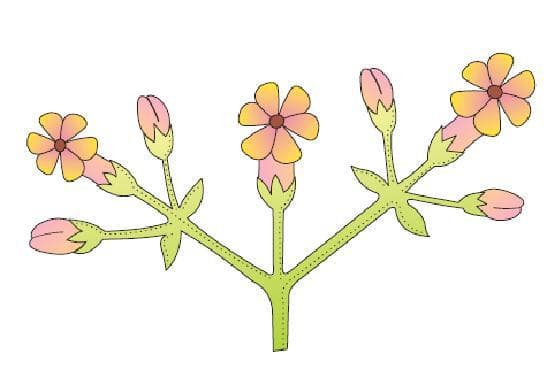
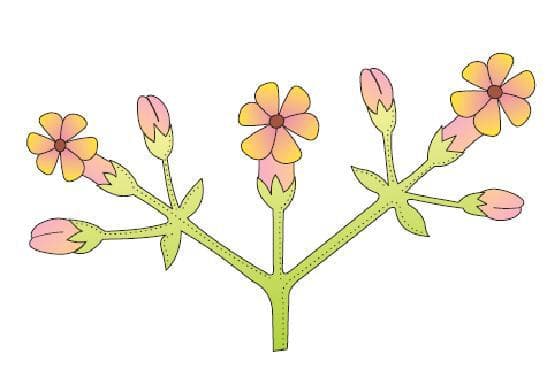
In cymose type of inflorescence,
Main axis terminates into flower.
Flower born in basipetal order.
Main axis not terminates into flower.
Flower born in acropetal order.

100% studentsanswered this correctly
Important Questions on Morphology and Modifications
EASY

MEDIUM
| List - I | List - II | ||
| (a) | Flowers appear to have arisen from the same point of peduncle | (i) | Corymb |
| (b) | The sessile flowers are arranged on peduncle in acropetal manner | (ii) | Umbel |
| (c) | The sessile unisexual and neuter flowers arranged in acropetal succession protected by a modified bract | (iii) | Spike |
| (d) | Unisexual and/or bisexual sessile flowers develop centripetally on a condensed peduncle | (iv) | Capitulum |
| (v) | Spadix |
The correct answer is
MEDIUM
In cymose inflorescence,
(a) The main axis terminates into flower.
(b) Flowers are born in acropetal manner.
(c) Young flowers are present towards the base and older at the apex.
EASY
MEDIUM
EASY
How many plants, in the list given below, have composite fruits that develop from an inflorescence?
Walnut, poppy, radish, fig, pineapple, apple, tomato, mulberry
EASY
EASY
EASY
EASY
MEDIUM
EASY
MEDIUM
MEDIUM
The most important function of inflorescence is to help in
MEDIUM
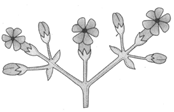
Identify the given diagram and choose the incorrect option.
MEDIUM
EASY
EASY
MEDIUM
EASY


